ICHRA vs traditional self-funded health plans

When employers compare ICHRA vs traditional self-funding, they want to know how much costs will fluctuate and who covers large claims: self-funded costs rise and fall with claims and ICHRA sets a fixed employer contribution.
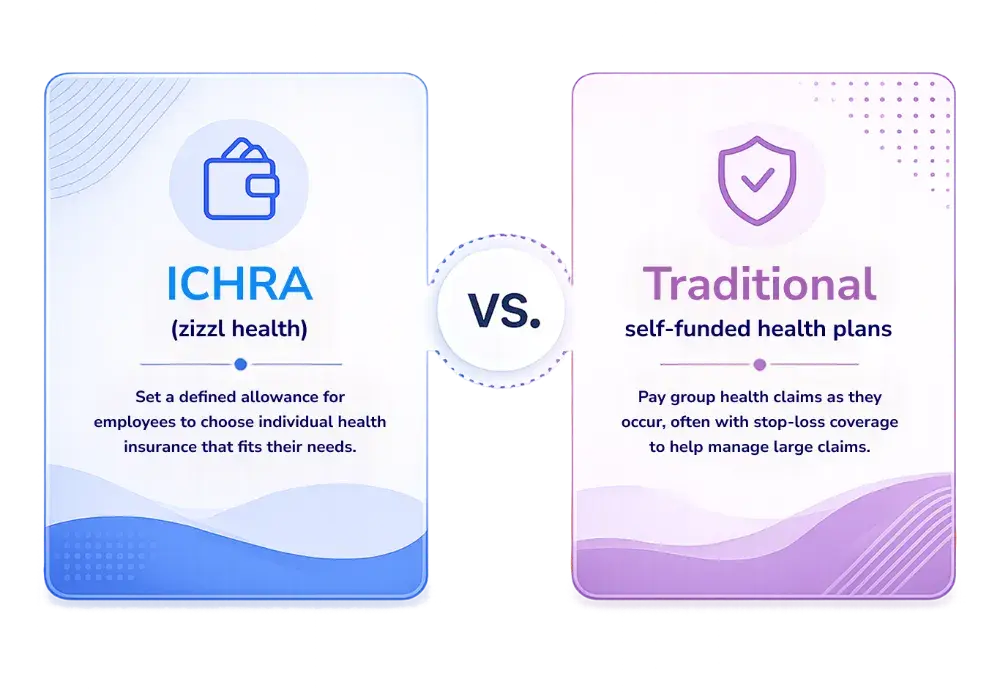
ivtsfHero

What's the difference between a self-funded plan and ICHRA?

The differences come down to plan structure, how costs are funded, where risk sits, and how employees choose coverage.
At-a-glance:
  • Structure: Self-funded is a group plan sponsored by the employer, with claims paid by the employer. ICHRA is an employer-sponsored arrangement that reimburses employees for individual coverage and eligible expenses.
  • Cost control: Self-funded costs are variable and primarily driven by claims. ICHRA costs are defined in advance through a set employer allowance.
  • Risk exposure: Self-funded employers carry claims risk, often with stop-loss to limit large claims. ICHRA employer costs are not directly tied to group claims experience, though individual premiums still vary based on age, rating area, and plan selection.
  • Employee choice: Self-funded plans usually offer employer-selected options. ICHRA allows employees to choose from individual plans available in their rating area.

ICHRA vs self-funded: a side-by-side comparison

Funding mechanics
Self-funded:
Claims are paid by the employer as they occur under a group health plan. Many employers use a third-party administrator to process claims and manage plan operations.
ICHRA:
A defined allowance is set by the employer, and employees are reimbursed for individual premiums and other eligible medical expenses under the terms of the arrangement.
Budget predictability during the plan year
Self-funded:
Total spend can vary throughout the year because claims do not arrive in a steady pattern. Employers' budget based on expected claims, administrative fees, individual lasers, and stop-loss premiums. Actual costs are reconciled against real claims experience.
ICHRA:
The employer defines the allowance in advance. Budget planning is centered on the contribution design rather than claim volume. Individual market premiums still vary by geography and age.
Claims risk and stop-loss exposure
Self-funded:
The employer is financially responsible for claims, which means higher-than-expected utilization can increase total cost. Stop-loss coverage can limit exposure to very large claims, but it does not remove normal claims variability.
ICHRA:
Employer costs are not tied to group claims; they're defined by the set allowance. Individual premium pricing is based on factors such as age and rating area, not employer-specific utilization.
Plan design and employee plan choice
Self-funded:
The employer selects the plan design and coverage options. Employees choose among the options offered, typically within the employer's selected networks and carriers.
ICHRA:
Employees select and enroll in their own individual plans from options available in their rating area. The employer sets the allowance but does not select the plan.
Monthly cost variability
Self-funded:
There is not a fixed group premium in the same way as a fully insured plan. Costs are primarily driven by claims. Employers also pay fixed administrative fees and stop-loss premiums. Monthly spend varies based on when claims occur and how large they are.
ICHRA:
Premiums are based on individual market factors such as age, rating area, and plan selection. Premium costs can vary across geographies, and the employer's reimbursement is limited to the defined allowance.
Operational administration
Self-funded:
The employer is responsible for overseeing plan operations. This often includes working with a TPA, coordinating stop-loss coverage, and managing eligibility and enrollment processes. Employers also handle required reporting and employee communications.
ICHRA:
Employers establish plan documentation, employee classes if applicable, reimbursement processes, substantiation, and required notices. If the employer is an applicable large employer, affordability design is part of setup.
Renewals and ongoing oversight
Self-funded:
Plan management typically includes monitoring claims experience, coordinating vendors, handling employee changes, and managing stop-loss renewals and plan adjustments over time.
ICHRA:
Plan management typically includes reimbursement administration, documentation tracking, class eligibility monitoring, notice timing, and ongoing compliance oversight.
Employer compliance responsibilities
Self-funded:
Employers are responsible for group health plan compliance requirements, including ERISA obligations and applicable federal benefit laws. Plan administration must also align with how claims are processed and documented through the TPA.
ICHRA:
Employers must structure the arrangement to follow class rules, notice requirements, substantiation guidelines, and affordability standards for applicable large employers. Ongoing compliance oversight is required to maintain the arrangement's status.

When does ICHRA make sense vs. self-funded?

The right model depends on your budget goals, your tolerance for claims volatility, and how much administrative lift your team can support.
Self-funded plans make sense when:
  • The organization can absorb claims-driven cost swings during the year.
  • Leadership wants direct control over plan design and is comfortable managing vendors.
  • The employer has the scale to support stop-loss underwriting and ongoing monitoring.
  • The organization wants more direct visibility into claims activity and plan performance.
  • Leadership is comfortable with stop-loss as part of the risk management approach.
ICHRA makes sense when:
  • The employer wants to define and manage benefit spend through a set allowance.
  • Claims volatility has made budgeting difficult year over year.
  • A large specific individual laser is put on an employee.
  • The workforce spans multiple states or rating areas, and employees need local plan options.
  • Employees value broader carrier and plan choice in their home market.
  • The organization is evaluating self-funded health plan alternatives that reduce reliance on claims-driven cost outcomes.
See How ICHRA Works

What outcomes can look like with ICHRA

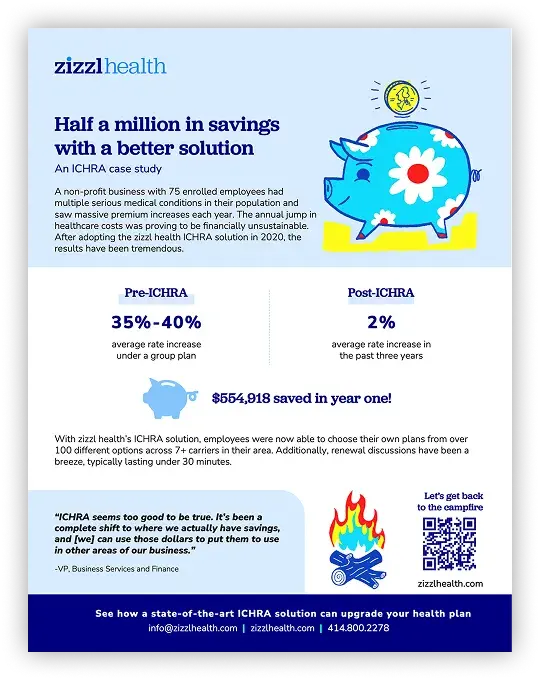
Below are two case study snapshots that show what changed after each employer moved to ICHRA.
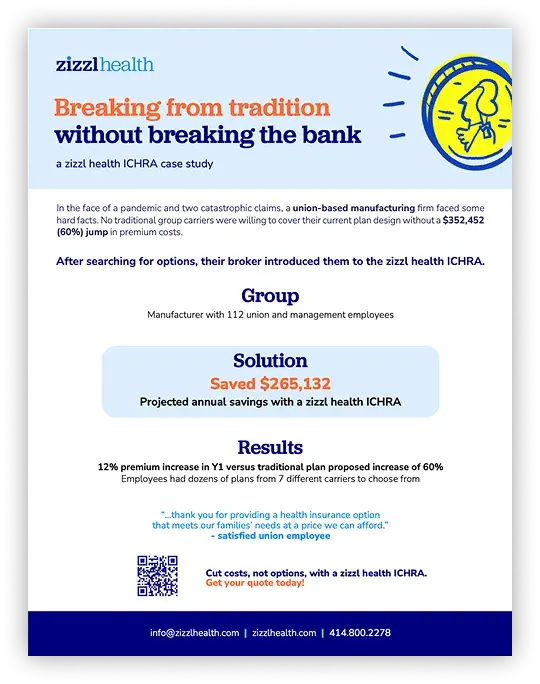
zizzl health ICHRA case study: Breaking from tradition without breaking the bank
Union-based manufacturer
  • 60% proposed increase under the prior approach
  • 12% increase in year one after moving to ICHRA
  • $265,132 projected annual savings
Read the Case Study
Growing non-profit
  • 35% to 40% typical annual increases under the prior approach
  • 2% average increase over the next three years after moving to ICHRA
  • $554,918 saved in year one
Read the Case Study
zizzl health ICHRA case study: Half a million in savings with a better solution
ICHRA FAQs

In a self-funded plan, the employer pays claims and total cost varies with utilization. In an ICHRA, the employer sets an allowance and reimburses employees for individual coverage and eligible expenses, so employer cost is tied to the contribution rather than claims.

Yes. When properly structured and administered, ICHRA is considered employer-sponsored group health coverage under federal rules.

Not always. Some years can come in under expectations, and some years can exceed projections due to claim timing, large claims, and utilization patterns. Stop-loss can reduce exposure to very large claims, but it does not remove normal variability.

ICHRA reduces the connection between employer cost and group claims experience, but it still requires careful design and compliance management. Employers also need to plan contribution levels with geography and workforce needs in mind.

Employees enroll in individual health insurance available in their rating area, and the employer reimburses eligible expenses up to the allowance amount.

It depends on affordability. If the ICHRA offer is affordable under ACA guidelines, the employee generally is not eligible for premium tax credits. If it is not affordable, the employee can decline the ICHRA and may qualify for premium tax credits based on eligibility rules.

Support varies. Some employees are comfortable shopping for individual coverage, and others want help understanding plan options and provider networks. This is one reason employers considering self-funded health plan alternatives often plan for additional education in year one.

Do Not Sell or Share My Personal information Limit the Use Of My Sensitive Personal Information