ICHRA for employers ready to regain control of health benefit costs

Gain control over rising health benefit costs with a defined contribution approach. ICHRA stabilizes your budget and expands employee choice, while zizzl health manages implementation to keep the transition structured and compliant.

What is ICHRA?

empTraditionalIcon

Traditional group plan:

  1. 1 Carrier sets renewal
  2. 2 Employer reacts
  3. 3 HR compromises plan design
empZizzlIcon

ICHRA with zizzl:

  1. 1 Employer sets a monthly contribution
  2. 2 Employees choose individual coverage
  3. 3 zizzl manages setup, payments, compliance, and support
ICHRA (Individual Coverage Health Reimbursement Arrangement) = a defined contribution health benefits strategy where employees choose individual plans.

See how ICHRA works for your organization and employees

Transitioning from a traditional group plan can feel uncertain. See how zizzl health manages enrollment and renewals to simplify the experience and protect your budget.

Real employer outcomes with ICHRA

Employers facing double-digit renewals have transitioned to ICHRA and stabilized their health benefit budgets without reducing employee choice.
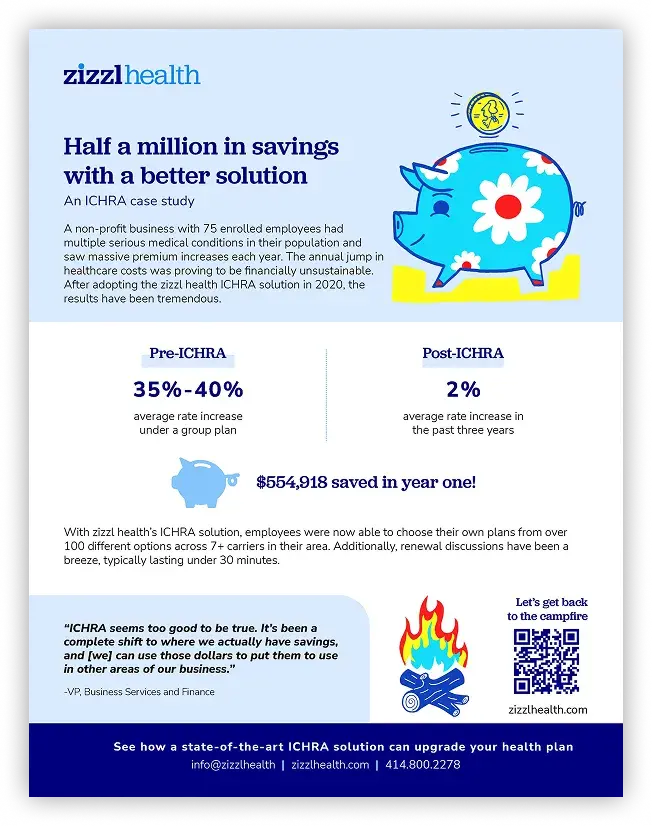
Nonprofit ICHRA case study preview
Over $550,000 Saved in Year One
After transitioning to ICHRA, this nonprofit replaced 35–40% annual increases with stable renewal performance and predictable budgeting.
Download the Nonprofit Case Study
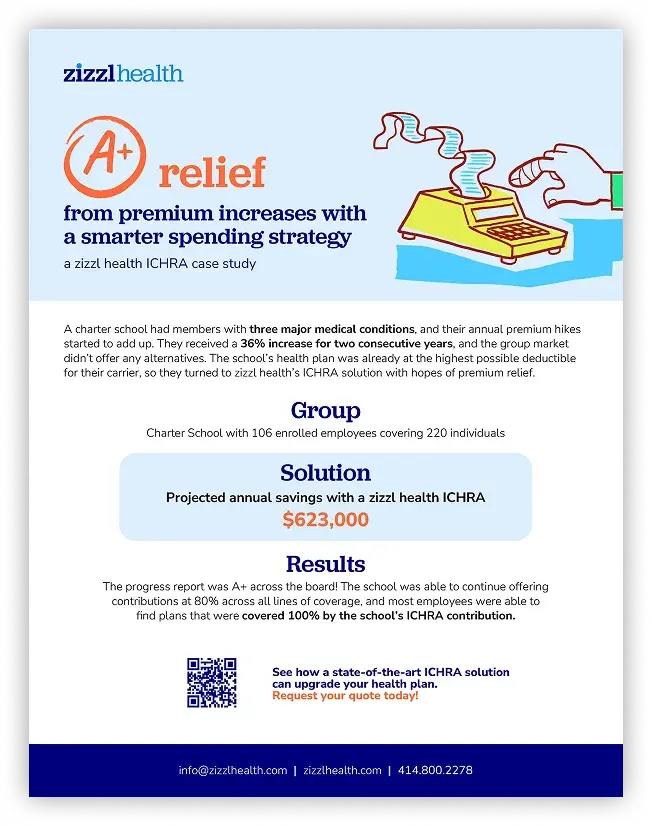
Charter school ICHRA case study preview
$623,000 in Projected Annual Savings
While Maintaining 80% Contributions
Following consecutive 36% increases, this charter school transitioned to ICHRA and preserved employer generosity while improving cost stability.
Download the Charter School Case Study

An employer health benefits alternative that breaks the renewal cycle

Premiums keep climbing, options keep shrinking, and every renewal puts you in a reactive position.
Under a traditional group plan, renewal usually looks like this:
  • Annual renewal increases frequently in the double-digit
  • Fewer carrier options in many regional markets
  • Plan design compromises to offset rising costs
  • Administrative complexity tied to underwriting and claims experience
The independent data is clear:

79% of employers

are now aware of ICHRA, up from 54% last year1

67% of employers

offering ICHRA report being very or extremely satisfied with the program1

65% of employers

who have offered both traditional group coverage and ICHRA say ICHRA provides better employee outcomes1

62% say ICHRA is better

for controlling employer healthcare costs1
ICHRA shifts employers from claims-driven renewals to a defined monthly contribution model, where costs are set in advance and change only if the employer chooses to adjust contribution levels.
1Deft Research. (2026). Commercial Group and ICHRA Study.

What zizzl health's ICHRA solution delivers for employers
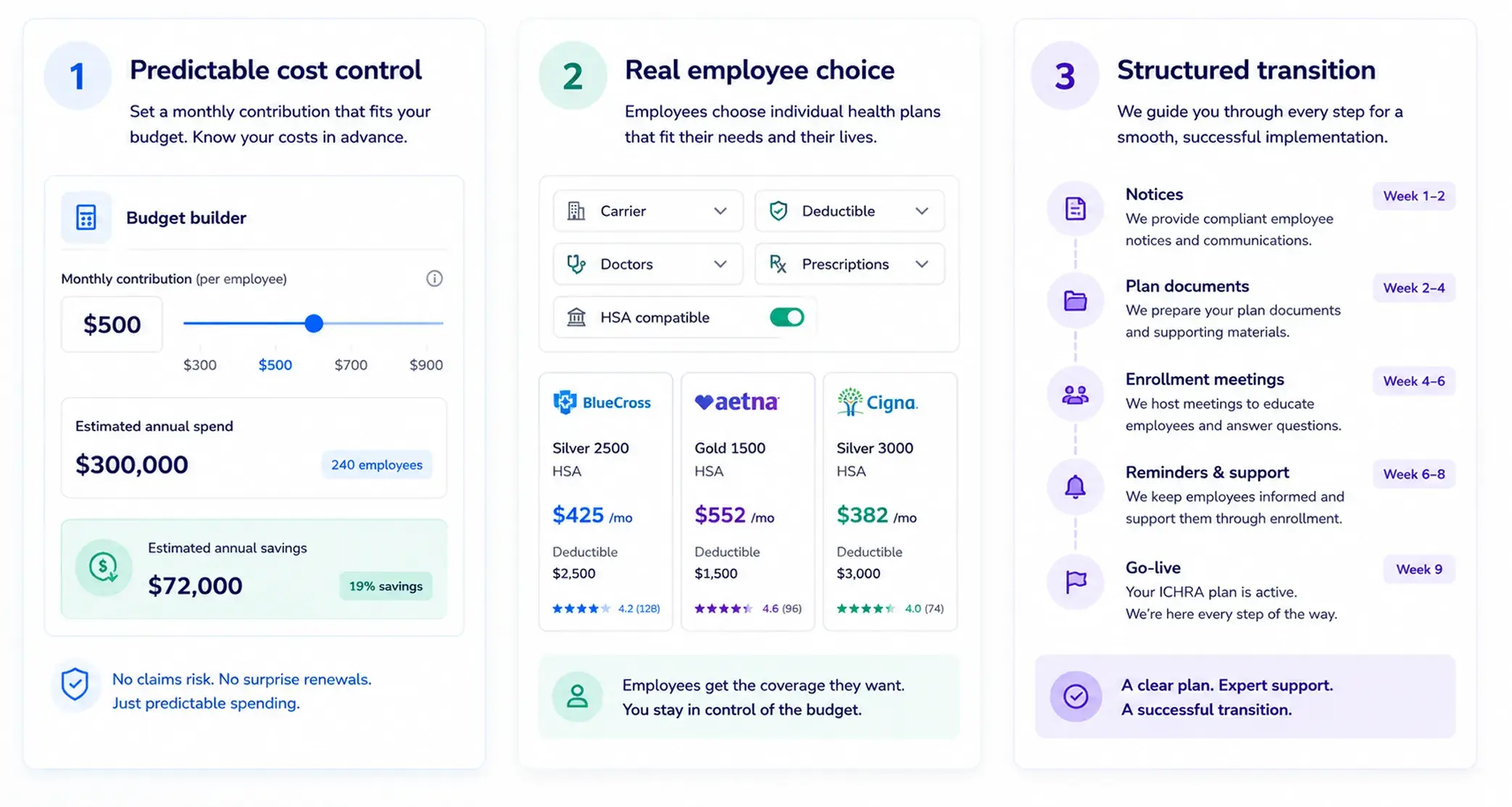

Three ICHRA advantages for employers: predictable cost control, real employee choice, and a structured transition
Compare ICHRA to Traditional Group Coverage
For a side-by-side visual breakdown of how ICHRA differs from traditional group health plans, including plan choice and carrier access, download our employer comparison overview.
Compare ICHRA and Traditional Plans

What real employers are saying

ICHRA seems too good to be true. It's been a complete shift to where we actually have savings … and can use those dollars to put them to use in other areas of our business.”
Client company logo
I was surprised by the number of quality plans available from major health insurers under the program and how much support would be provided to employees throughout the transition.”
Client company logo

“When it was all said and done, the company and its employees were thrilled with the results of an ICHRA benefits plan.”

Client company logo

The zizzl health difference for employers

zizzl health supports employers through contribution modeling, compliance documentation, employee communications, enrollment coordination, and ongoing administrative support.
Cost control by design
Employers set the contribution amount, which can vary by age to reflect age-rated premiums. Contributions may cover employees only or include dependents. Employers also have the option to utilize ACA-recognized classes, like Salaried and Hourly, to design benefits.
Proof that it works
  • Employers who have offered ICHRA for four years or more report satisfaction levels that match or exceed traditional group plans1
  • 73% of employers say that their employees' satisfaction with ICHRA is similar or much better compared to traditional group coverage1
Built-in compliance
Offering ICHRA requires:
  • A formal plan document
  • Required employee notices
  • ACA compliance
  • A Section 125 plan for pre-tax deductions
Our team prepares required plan documents, distributes mandated employee notices, and ensures contribution design aligns with ACA guidelines.
Download the 2026 ICHRA Report
1zizzl health and Deft Research, 2026 ICHRA Report.

Ancillary benefits that support your ICHRA plan

ICHRA doesn't replace your entire benefits strategy. It becomes the foundation.
Compatible by design
ICHRA works alongside:
  • Health Savings Accounts
  • Flexible Spending Accounts
  • Traditional Benefits like Dental, Vision, and LTD
Employers can offer one or more alongside ICHRA to support out-of-pocket expenses and savings strategies.

Long-term employer value
For many organizations, ICHRA becomes the core funding strategy for employers. Complementary benefits layer on top to maintain competitiveness without reintroducing cost volatility.
How they integrate
ICHRA defines the employer contribution for premiums and eligible expenses. HSAs, FSAs, and additional coverages like dental, vision, and LTD operate within that structure to help employees manage deductibles, copays, and other qualified costs.
When paired with a qualified high-deductible individual plan, employees remain eligible to contribute to an HSA. FSAs may be structured as limited-purpose when coordinated with an HSA-compatible design.
Is ICHRA right for your business?
See If ICHRA Fits
Employer FAQs

Employers of any size may offer an ICHRA to any type of worker, including full time and part time employees.

Employers don't select the insurance company or the plan(s) when using an ICHRA for health insurance benefits. They simply determine how much they want to contribute towards the benefit and employees select their own insurance company and plan. Plan rates are community rated and not subject to underwriting, claims experience, or health conditions. If an employee applies for a plan, the insurance company is obligated to sell them the plan at the published rate.

ICHRA plans are considered ACA compliant as all qualified plans provide minimum essential coverage and employer contributions can be structured to be affordable. COBRA also applies for employers subject to ERISA law. However, state continuation does not apply.

ICHRAs are compatible with both health care flexible spending accounts and health saving accounts. Employers can offer one or both in conjunction with an ICHRA.

Employers may pay insurance companies on behalf of each employee and payroll deduct the employee contribution if their premium exceeds the employer contribution. This method has the advantage of a familiar “group plan” feel to employees. Alternatively, employers may require employees to pay the entire premium and submit a reimbursement request for the employer contribution. This method creates cash flow and inconvenience issues for some employees. zizzl health facilitates these payments on behalf of the employer and their employees.

Individual health insurance rates are at parity or lower than small group rates in many states, and this trend continues to grow.

Do Not Sell or Share My Personal information Limit the Use Of My Sensitive Personal Information